Showing posts with label Julia Quinn. Show all posts

Wednesday, January 20, 2010

Dancing At Midnight, by Julia Quinn - Review

I think this is one of those cases where I like a particular author well enough to forgive a multitude of sins. Dancing At Midnight is a 1995 title, so Quinn has put a lot of pages under her belt since this one. And often when I go into a favorite author's backlist, I'm disappointed by the skill level of their earlier stuff.

I'll say that her recent books are much, much better. More polished. Less flawed.

But somehow I was still charmed by this story, mostly thanks to the cheerful, sweet heroine. Only slightly quirky and without an angstrom of existential angst, Belle has a personality that leaps off the page without being caricaturish. She keeps her head on her shoulders (so to speak) and doesn't suffer John's foolishness gladly. I liked her lots and lots, and she carried the book for me.

John is OK, but I'm not a big fan of the "I'm not good enough for her, therefore I will push her away FOR HER OWN GOOD" trope, and for the most part John did not rise above his trope. He had some good moments though, notably where he and Belle are enjoying each others' humor and wit-- moments of connection that I recognized from similar good times in my own best relationships. Moments when you're thinking: "this person gets me."

It would be easy to pick this book apart on technicalities but I'm stubbornly going to say: I liked it anyway. If you're a big fan of Quinn's heroines and dialog, you'll like it too. If you're in a highly critical mood or looking for the subtlety and deftness of her 21st-century books, eh, maybe take a pass on it.

Wednesday, July 1, 2009

Hot Summer Historicals

THREE of my favorite authors released new books yesterday! Scheduling a trip to Borders' ASAP...

In no particular order:


What Happens in London, by Julia Quinn

Don't you love the title? Truthfully, the Vegas slogan is wearing a bit thin for me, but somehow Quinn's twist makes me smile. I do enjoy the occasional camera-asides, where books or movies or tv shows acknowledge that that's exactly what they are, and sort of bring the audience right into the joke. If that makes any sense at all. Anyway, it says classic Quinn sly humor to me.


Don't Tempt Me, by Loretta Chase.

I don't know what I can say about Chase that I haven't already: Auto-buy. Can't wait!


Loving A Lost Lord, by Mary Jo Putney

It's weird. I love MJP, and I love paranormal romance, but I really, really did not love her paranormal historicals. In fact I sort of hated the one I read and ignored the others. So I'm EXTREMELY HAPPY to see that she's returning to straight historicals with this series. Yay!


Head On Over
to Romance Vagabonds for really good interviews with Quinn and Putney. Then head to your local bookseller and indulge

Saturday, December 6, 2008

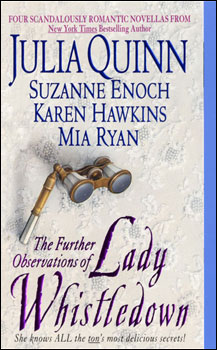
The Further Observations of Lady Whistledown – Anthology – Review

If you’re a fan of Julia Quinn’s Bridgerton series, then you’re well-acquainted with Lady Whistledown, the anonymous society lady who writes the wildly popular gossip sheet about London’s ton.

The fun part about this anthology, unlike many others, is the fact that the four stories bump into each other around the edges, much like you might expect four actual affairs going on within, loosely, the same large social set. They don’t have too much impact on each other, but there are a couple of events that we get to see from several different vantage points, which I think is always fun. And then there’s the narration of Lady Whistledown. Her gently snarky commentary is funny, never truly kicks anyone who’s down, and serves as a wry window into the foibles of the nobility from someone who lives in the midst of it.

Briefly then –

*Suzanne Enoch leads us off with a nineteen-year-old virgin theme. Not my fave, but probably the most historically accurate for a Regency, so, you know, I’m used to it and I deal. It has a classic arranged-marriage conflict – not much in the way of word-count is needed to get us up to speed on that. We do get to see these characters come around from playing the role that’s expected of them, to really seeing each other as individuals and figuring out how to compromise. Nicely done if not especially memorable.

*Mia Ryan’s Lord Darington, has to be the most… endearing hero I’ve some across in a long time. I can’t find the right word. “Endearing” makes him sound like a puppy or a child, and that’s not what I mean. He has a serious vulnerability, and when he exposes it to the heroine, it’s really a wonderful scene, especially for a short. “A Dozen Kisses” is a nicely wrapped testament to the adage that Appearances can be Deceptive. It wins my vote for “Best Love Letter Ever,” too.

*I loved Karen Hawkins heroine, loud wardrobe and all (I did sort of wonder a bit if the character was color-blind, but that didn’t go anywhere). This is a Best Friend theme that hits all the right notes; it’s not a sudden transformation of a friendship—the whole story is really a progression where the characters realize that their friendship has been masking deeper feelings all along. My only complaint is that the hero seemed genuinely puzzled as to why the heroine would want to get married—hello, duh, sex? Anyway.

*Quinn’s “Thirty Six Valentines” is a sweet-cotton-candy melt-in-your-mouth fluff of a story. It’s almost more of a character sketch than a story, but I’m OK with that because the characters are eminently loveable, their vulnerabilities human and universal, and the sketches rendered flawlessly.

In direct contrast to Betsy’s complaint about the Foster and Phillips stories, these four all show us couples falling in love. As Betsy so eloquently put it, the relationship is the action. Plot and conflict are scaled down to novella-length, but I really felt like the characters and the chemistry still got the full, royal treatment in all four stories.

____________
p.s.: Visit Devon's blog for her latest anthology review.

Sunday, November 9, 2008

Mistress of Pleasure, by Delilah Marvelle – Review

One of the recent highlights of my avocation as a romance reader was the Emerald City RWA conference in Bellevue, WA. This just happens to be about 8 miles from my house. I am steadfastly NOT writing a romance. No. Not doing it. As tempting as it sounds to attend a seminar by Julia Quinn on writing dialog, or Cherry Adair as the motivational “just do it” speaker (no really, it IS tempting, that isn’t sarcasm), I would rather spend the $300-odd on books by other people. Seriously, it’s way more fun to read them than it is to write them. At least for me.

**WARNING: NAVEL-GAZING AHEAD**

So, the thing is, as an artist, I’m a damn good engineer.

I do not mean to say that I’m utterly hopeless at creative stuff. For any art, there is craft that can be learned and practiced, skills that enable the artistic vision to shine through. My husband, who’s a 3-D electronic artist, has said that when his company looks for artists, they’d far rather have someone with a great artistic eye and teach them the software, than someone who’s a whiz with the package of the moment but merely OK at the art. Me? I’m pretty good at the craft stuff. If I can read up on it, and practice it, and have sufficient motivation, I can perform competently. It’s that vision, that creative spark, that I think I lack, or perhaps it’s just the faith in my spark that's missing. Either way, I’ve yet to catch fire.

So back to the review, and how it came to be: I was standing in line loaded down with a huge tote full of juicy new books, and started chatting up the person next to me (it wasn’t Ciara, though I did accost her in her FABulous boa and got a bit of a scoop on how things were going) and probably talked her ear off – I tend to do that when I get going on the topic of romance books (I’m sure you’re shocked). Julia Hunter held up to the barrage pretty well, and told me that I HAD to check out Marvelle. You can probably imagine how much arm-twisting was involved. Julia graciously held my place in line (there were like 50 people ahead of us and 4 behind) while I ran back and nabbed one last book.

Delilah Marvelle was the nicest person you could imagine to talk to and her books have a pretty cool premise. She writes in the regency era, but less about the ton and more about the demi-monde, or that class of folks, especially women, who might be welcomed into the rarified air of the ton, if only they would behave themselves.

Intrigued?

So was I. Honestly, I really, really wanted to be able to write a rave review for this book, but I found it only so-so. It seems to me that Marvelle has the spark, the idea, the passion, but it’s executed a little clumsily. Anachronistic patterns of speech, dialog that clunks along sometimes, especially the grandmother’s French inflections. Plot devices that don’t quite ring true – in particular, the hero is a duke who, despite being handsome, fit, of a prime age, and – did I say—a bloody duke?-- is considered unmarriageable because of recent family scandals. His mother, overbearing but loving, is so desperate for him to marry that she pressures him to marry a woman who has no reputation, no money, and no family lineage – she’s not quite a courtesan, but the next thing. The heroine meanwhile, is a prim virgin saddled with a grandmother who has educated her in the theory of sexual arts to a degree that rather squicked me out. Now, I realize that there’s a deliberate attempt here to turn gender roles on their head, but I just didn’t really buy it, on either side.

In spite of all the problems though, I still really like the basic premise (a very secret "School for Scandal" where men of the ton can learn the arts of seduction) and I loved the glimpses of the gentlemen who will become the subsequent heroes. Marvelle tells us that she’s planning to write 5 or 6 books with a concurrent time frame, and I’m looking forward to that. I’ve always loved reading the same scene from more than one point of view (see also: Julia Quinn, “The Lost Duke of Windham” & “Mr. Cavendish, I Presume”).

If I haven’t made my point yet on craft vs. art, I feel like Marvelle has the art but needs a little work on the craft. Which is why I’ll be happy to pick up at least the next book and see what happens with it--I'd rather read a book with this kind of flaw than a perfectly-written one with no heart.

Sunday, September 7, 2008

Series Reading Order

It’s been pointed out to me that I generally don’t bother to list the reading order for the various series that I review. I figure that it’s usually pretty easy to ferret out from either Amazon or the author’s website, but I’m all about the feedback, so if that’s a service my readers want, I’m happy to oblige.

So here’s the reading order for a few of the series that I’ve talked about in the past:

Historicals

The Bridgertons, by Julia Quinn

  1. The Duke and I

  2. The Viscount Who Loved Me

  3. An Offer From A Gentleman

  4. Romancing Mr. Bridgerton

  5. To Sir Phillip, With Love

  6. When He Was Wicked

  7. It's In His Kiss

  8. On The Way to the Wedding


The Cynsters, by Stephanie Laurens

  1. Devil’s Bride

  2. A Rake’s Vow

  3. Scandal’s Bride

  4. A Rogue’s Proposal

  5. A Secret Love

  6. All About Love

  7. All About Passion

  8. The Promise in a Kiss

  9. On a Wild Night

  10. On a Wicked Dawn

  11. The Perfect Lover

  12. The Ideal Bride

  13. The Truth About Love

  14. What Price Love?

  15. The Taste of Innocence (wasn’t crazy about this one)


The Bastion Club, by Stephanie Laurens

  1. Captain Jack’s Woman (prequel—meh)

  2. The Lady Chosen

  3. A Gentleman’s Honor

  4. A Lady of His Own

  5. A Fine Passion

  6. To Distraction

  7. Beyond Seduction

  8. The Edge of Desire


The Carsington Brothers, by Loretta Chase

  1. Miss Wonderful

  2. Mr. Impossible

  3. Lord Perfect


Contemporaries:
Huh. It looks like most of the contemporaries I’ve talked about are not part of series, but more stand-alones. Leave me a comment if there are series that I’ve missed!

Paranormals:
Ah, paranormals. So many series, so little time. I’m just going to do a few here, or this post will be ridiculously long.

First up, of course, is JR Ward’s Black Dagger Brotherhood:

  1. Dark Lover

  2. Lover Eternal

  3. Lover Awakened

  4. Lover Revealed

  5. Lover Unbound

  6. Lover Enshrined

  7. The Black Dagger Brotherhood: An Insider’s Guide (coming in October 2008)

  8. Dead After Dark* (coming in December 2008)

  9. Lover Avenged (coming in May 2009)


Meljean Brook’s Guardian Series:

  1. Hot Spell*

  2. Demon Angel

  3. Wild Thing*

  4. Demon Moon

  5. Demon Night

  6. First Blood*

  7. Demon Bound (coming in November 2008)


Nalini Singh's Shifter/Psy series:

  1. An Enchanted Season*

  2. Slave to Sensation

  3. Visions of Heat

  4. Caressed by Ice

  5. The Magical Christmas Cat* (coming October 2008)

  6. Mine to Possess

  7. Hostage to Pleasure

  8. Branded by Fire (not yet released, but the exerpt is page-meltingly hot)


Kresley Cole’s Immortals After Dark series:

  1. Playing Easy to Get*

  2. A Hunger Like No Other

  3. No Rest for the Wicked

  4. Wicked Deeds on a Winter’s Night

  5. Dark Needs at Night’s Edge

  6. Dark Desires After Dusk

  7. Kiss of a Demon King (coming in Feb 2009)

  8. Not That Innocent* (coming in May 2009)


Lynn Viehl’s Darkyn Series

  1. If Angels Burn

  2. Dark Need

  3. Private Demon

  4. Night Lost

  5. Evermore

  6. Twilight Fall

  7. Stay The Night (coming in Jan 2009)


*Titles with an asterisk are anthologies which contain a novella or short story within the same universe as the series.

That help, Erin? I hereby promise to include the reading order for any series I review in the future. :-)

Friday, February 22, 2008

Julia Quinn's Bridgerton books

Nicola: On the advice of my esteemed co-blogger, over the last couple of weeks I have jumped into the Julia Quinn/Bridgerton books with both feet. Errr, eyes? Anyway.

There are eight books in the main series, one for each Bridgerton sibling. Due to a combination of UBS availability, lack of patience, and issues with reading comprehension, here is the order I read them in: 8,1,2,7,3,5,4,6. Happily, that means I can vouch for the ability of each book to stand alone.

O’Donovan has said that the great thing about the Bridgerton books is the loving and witty interaction of the large Bridgerton clan, and the ongoing glimpses of the various inter-relationships. I’m going to take it a step further and say that the great appeal of the Bridgerton family is that they are a literary and real-world rarity: a functional-- as in the opposite of dysfunctional-- family.

O’Donovan: I’ve been musing about this since Nicola first mentioned this notion and I completely agree … and yet. As someone who grew up in a family that is almost sickeningly functional and strong, I shy away from “functional” as a description precisely because it has a connotation of perfection, at least as people use it in talking about families.

Nicola: Funny, I always thought the word “functional” was sort of damnation by faint praise. As in, defined by a lack of deviant horrible behavior….

O’Donovan: What I love about Quinn is that her families are functional – if the function of a family is to love and support one another – but they also manage to be irritating, challenging, suffocating and quirky. I like that she gives us something better than Ozzie-and-Harriet-style perfection: It’s a bunch of very “real” fictional people all bound by a commitment to each other.

The funny thing is, that’s pretty much the description of all the best (romantic) love stories, too.

Nicola: yep, check, check, and check. I also grew up really really lucky: although mine is a family of 3 girls, and not the 8 siblings of Bridgerton fame, I have a large, close extended family and that’s a really accurate description. There’s lots of internal joshing and teasing that occasionally approaches jabs and pokes, but to the outside world? It’s a united front, all the way. Are they perfect? Heck no. Do they drive me crazy? Oh yes. Would I change the slightest thing about any of them? Not for the sun and the moon and the stars.

So, then, moving on: when I first got married, my mother-in-law gave me a book called The Good Marriage. Without going into a lot of details, what the authors identified as a “rescue marriage” was of particular interest to me. In trying to add some context for you, I find my options are the one-sentence sound-byte:
Description of a rescue marriage: The healing that takes place during the course of the marriage is the central theme.

Or alternatively, four chapters worth of empirical description--you’ll have to get hold of a copy of the book for that.

The bottom line is, I recognize most of the Bridgerton-Spouse relationships as rescue marriages, or at least one such flavor. The Bridgertons, by and large, are fully realized, emotionally healthy adults, though of course not without their insecurities and yet-to-be-fulfilled dreams—and isn’t that a refreshing change of pace? Their spouses are mostly abused and damaged, feeling by turns envious of the Bridgerton family warmth, unworthy to join it, overwhelmed by it, and finally, embraced and healed by it. That last phase is particularly delightful to see in small bits and pieces of later books and epilogues, and a big part of the appeal that O’Donovan spoke of in her post on Relational Romance .

Does this mean that the Bridgerton half of the couple is the rock, the strength, selflessly giving to a weaker spouse who’s a needy, emotional black hole? Well, no, because that would be really irritating, not to mention boring. What most of the Bridgerton sibs have in common is a guilty wish to be more separate from the pack, to be recognized as an individual.

And the non-Bridgerton spouses are anything but weak. It’s more a case of “what doesn’t kill you makes you stronger*”, and the experiences of these partners give them an almost Herculean strength. Watching them learn to accept a partner, to set down a little of their burden, is a moving experience every time. Often, their difficulties are what allow them to see beyond the façade of Bridgerton strength to the individual’s needs and the weaknesses that they don’t dare show.

O’Donovan: This is a very key point, I think, but I want to address the one Bridgeton book where it was turned on its head. In When He Was Wicked, I think Francesca is the “rescued” half, and she is rescued, at least in part, from her stifling identity as one of eight Bridgerton siblings. That turnabout has made it one of my favorite JQ books, and I thought it widened the scope of the series from the “cool family rescues the world’s strays” theme to the breadth of strengths that you describe here.

Nicola: Now that’s interesting, because Francesca’s partner in WHWW, while not abused, has certainly done some emotional suffering, and I don’t think of Francesca as in need of a rescue. But I agree that they are the most evenly matched couple, in those terms. I also loved this book (just finished it, in fact) and thought it was interesting that while I was formulating all these thoughts about the Bridgerton family, here was this book waiting for me that takes place almost entirely separately from the family. It’s not that Francesca doesn’t seem like part of the family, it’s more that the family and its dynamics don’t really play such a major role in this story as it does in the others. And to be honest, I have a certain soft spot for heroines who aren’t virgins. (Make of that what you will.)

Julia Quinn does a very nice job, all in all, of consistently demonstrating that a person’s greatest strength can also be their greatest weakness. The spouses that the Bridgertons find themselves with are tenderly complementary in both ways.

__________
* "What doesn't kill you makes you stronger." Ugh. I hate that sentiment: it basically rationalizes abuse. It's true that crappy experiences CAN make you stronger, but they can also wear you down and damage you without killing you..... well, anyway. Pet peeve. Sorry for the tangent.

Wednesday, January 30, 2008

Relational romance

Talking with Nicola about J.R. Ward’s heroes – and, specifically, why I am so drawn to that series, almost despite myself – I keep coming back to the non-romantic relationships in the books.

In the industry, these characters are called “secondary.” Hmph, I say. Secondary to what? To the romance? I’ll agree with that, but not with the idea that they are secondary to the action or the nature of the novel.

Let’s face it: Straight romance doesn’t have a ton of surprises to offer us. It can be well written or badly written, sweet or erotic, cozy or adventurous, but there’s rarely a question of whether it will end happily. It will end happily. That’s the point.

So how do we set one romance novel apart from the others? I would argue that the best books on the market today are the ones where the secondary (and tertiary!) characters are as real and engaging as the hero and heroine.

I thought I would make a list of authors (and/or series) that I love because of the secondary characters:

Julia Quinn’s Bridgerton books
I wonder if this series (beginning with The Duke and I) would be nearly so fun without the initially-unseen-except-for-chapter-headings gossip queen Lady Whistledown. Or, I ask you, without the other seven siblings mucking things up (or solving things) for whichever Bridgerton is the present protagonist? One of my favorite Bridgerton scenes has almost nothing to do with “romance,” and everything to do with how the heroine fits in with the hero’s family. In this scene, Kate has been invited to play croquet (or Pall Mall), and they’re setting up the course in the hero (Anthony’s) absence:

"Let me take half of those,” Daphne said, reaching for the wickets in her brother’s hand. “Miss Sheffield and I … that is, Kate and I”—she flashed Kate a friendly grin—“will set up three of them and you and Simon can do the rest.”
Before Kate could even venture an opinion, Daphne had taken her by the arm and was leading her toward the lake.
“We have to make absolutely certain that Anthony loses his ball in the water,” Daphne muttered. “I have never forgiven him for last time. I thought Benedict and Colin were going to die laughing. And Anthony was the worst. He just stood there smirking. Smirking!” She turned to Kate with a most beleaguered expression. “No one smirks quite like my eldest brother.”
“I know,” Kate muttered under her breath.
Thankfully, the duchess hadn’t heard her. “If I could have killed him, I vow I would have.”
“What will happen once all your balls are lost in the lake?” Kate couldn’t resist asking. “I haven’t played with you lot yet, but you do seem rather competitive, and it seems …”
“That it would be inevitable?” Daphne finished for her. She grinned. “You’re probably right. We have no sense of sportsmanship when it comes to Pall Mall. When a Bridgerton picks up a mallet, we become the worst sorts of cheaters and liars. Truly, the game is less about winning than making sure the other players lose. … It seems a waste, I know, but worth it to humiliate my brothers.”

Jennifer Crusie’s anything
I’ve often sold my friends on Jennifer Crusie’s books by telling them that they will never laugh as hard reading any other romance novel. She’s funny and the wit is sly, and a lot of it has to do with secondary characters acting as the voices of reason.

Let’s face it: The early stages of love make us all behave like idiots, and it’s only right that the love portrayed in romance novels should occasionally turn our heroes and heroines into idiots, too. And, to complete the cycle, that they have friends and families that will happily – gleefully, even – point it out.

Another thing to love about Crusie is that a lot of the tension in her romances comes from her couples having to deal with the insane vagaries of everyday life. They’re not so much beset by pirate ships and spy rings as they are plagued by families whose every-family-has-one craziness is magnified. Also? She’s not afraid to put a funny line in a woman’s mouth, and that’s a quality much to be prized. (Don’t you get sick of men being the only ones who are allowed to be overtly comic?)

Favorite Crusie book has got to be the utterly priceless Bet Me, although you honestly can’t go wrong with anything she writes, and you’ll definitely fall in love with her books co-written with Bob Mayer, and her books about the Dempsey family, starting with Welcome to Temptation.

Nora Roberts’ The Quinn Legacy
This is the story of three (well, four) adopted brothers who are dealing with their father’s death and the ongoing fight to keep custody of the fourth, significantly younger, brother. That tension and trouble runs throughout the first three books and it’s simply lovely.

As is usual for Roberts’s series, there are three basic “types”: The glamorous jetsetter sibling, the sensible, type-A sibling, and the salt-of-the-earth, quietly deep sibling. I think she does better cast development with the Quinns than with any other series; the brothers (all of whom end up with their own books) are nuanced and rude to each other and messy and imperfect in ways that are true to their typical Roberts archetype.

I’d argue that the secondary characters are fewer and shallower with Roberts than with other writers, but she’s one of the queens of the genre and this is her best work (imho), so I thought I should include it.

Susan Elizabeth Phillips’ football and golf books
Whaaa? Football and golf?

Football. And. Golf. Take it as an article of faith that anyone who loves character-driven, secondary-character packed romance will adore any SEP book that includes a pro athlete. (Which means football or golf; she hasn’t yet ventured into luge or pro wrestling, which would strain my faith as a reader.)

As I write this post, I’m discovering something interesting: I get really engaged in books that show the heroes (in particular) in a range of emotionally complicated situations (but that’s probably another blog post). SEP definitely deals those out, with difficult families, tenuous relationships, trust issues … you name it.

Perhaps my favorite SEP example is … hmph. It’s tough to isolate one, but I think it’s got to be Heaven, Texas, in which an entire town plays a role as a secondary character. There’s also the hero’s fantastic, widowed mother and the entire staff of the Curl Up and Dye hair salon. Gracie Snow (the heroine) ends up having to contend with all kinds of issues related to Bobby Tom Denton’s status as favorite son, and that means SEP got to really play around with the secondary characters and how they throw roadblocks in the path of, you know, True Love.


So, there you have it. My top picks for relational romances. Other authors who deserve a mention (but haven’t published anything that’s rung my bell in a while): Judith McNaught (try Perfect, a contemporary with one of my all-time favorite heroines) and Julie Garwood (The Secret should start you off well if you like historicals set in Scotland – or even if you don’t).

And, because I am on a serious fantasy and vampire kick right now, when I’m talking about relational, uh, quasi-romance, I simply must recommend all of Kelley Armstrong’s Women of the Otherworld books (start with Bitten).

Finally, for fantasy books with great loving relationships and romance that’s stretched across a trilogy, Patricia Briggs’ Mercedes Thompson books (starting with Moon Called) and Anne Bishop’s Dark Jewels trilogy (my absolute favorite comfort books ever, starting with Daughter of the Blood) are must-reads, but be warned: They have some seriously dark themes and very graphic violence.

The 2008 Look Ahead from O'Donovan

OK, I was inspired by Nicola's post to look ahead at the forthcoming lists and, wow, it's going to be a fab year in reading, as evidenced by the number of things I just preordered from Amazon.

On my list:

March 4 - Tangled Webs by Anne Bishop. Fantasy, mostly, but anyone who likes the much-discussed Black Dagger books (but would like less tic-filled writing) should read Anne Bishop's Black Jewels books

March 4 - Thigh High by Christina Dodd. I just love Christina Dodd's historicals; her contemporaries tend to be thrillers and not so much fun, but let's give it a shot, eh?

March 28 - Personal Demon by Kelley Armstrong. Kelley Armstrong is Canadian and funny and has tough, clever heroines and very satisfyingly modern romances, albeit with werewolves and vampires and demons.

May 27 - The Lost Duke of Wyndham by Julia Quinn. Thanks entirely to her Bridgerton books, Julia Quinn could pied piper me right off of a cliff. I'll buy anything she cares to write (although her pre-Bridgerton books, honestly, aren't crucial to own).

July 29 - Cry Wolf by Patricia Briggs. Her Mercy Thompson books are tough and sexy and tense and hot, and I have complete faith in her ability to deliver the same sexual tension and great plotting with Charles and Anna. (Although, according to the Briggs blog, this book is a running a little late; good God, I hate it when publishing dates get pushed back.)

June 3 - Lover Enshrined by J.R. Ward. I'm like a crack addict for these books. Crack. Addict.

Dec. 30 (or April?) - Can't Take My Eyes Off of You by Judith McNaught. I'll buy anything Judith McNaught wants to write, but I am crossing my fingers that she is still on top of her game. I fell for her and Jude Deveraux at the same time, and Ms. Deveraux books have really stopped appealing to me, while Ms. McNaught's are still must-haves. I guess we'll see.

OK, that's a long, dry spell between June and December. What am I missing?

Visitors

  © Blogger template Coozie by Ourblogtemplates.com 2008

Back to TOP